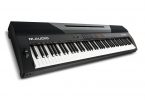
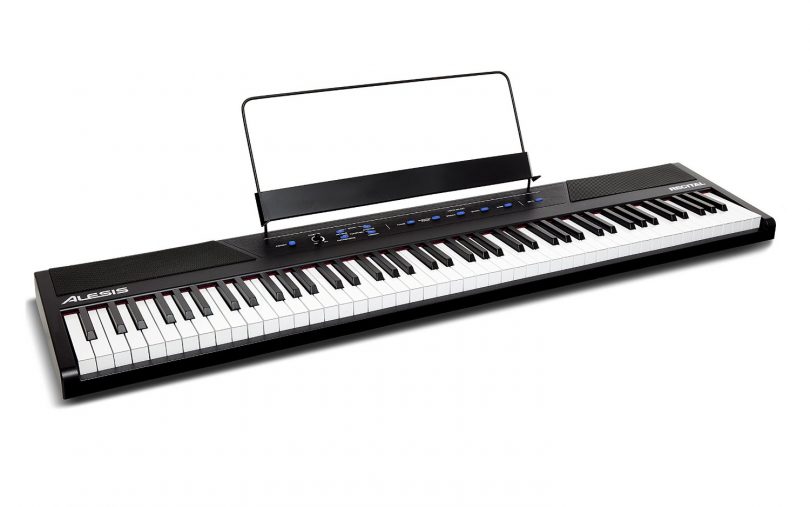

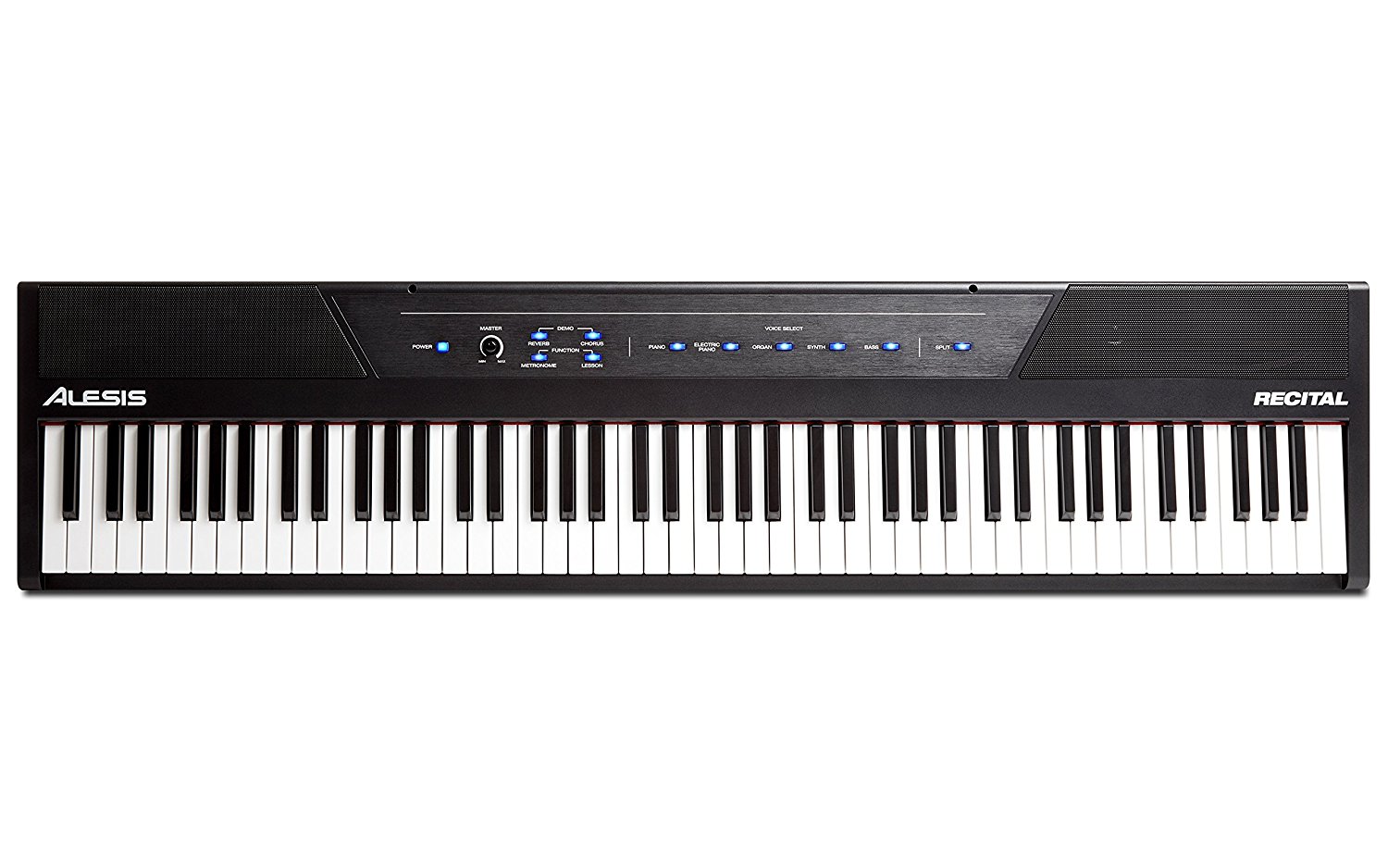
The Alesis Recital, with a fantastic body style, was designed for starters. The keyboard is ideal for those seeking to improve their skills as a pianist without the need to dole out stacks of dollars.
At the first glance, the futuristic design of the keyboard is evident. It carries LED buttons to finish the design well. Its lightweight and slender design makes it incredibly simple to store and appears quite pleasant in many living areas.
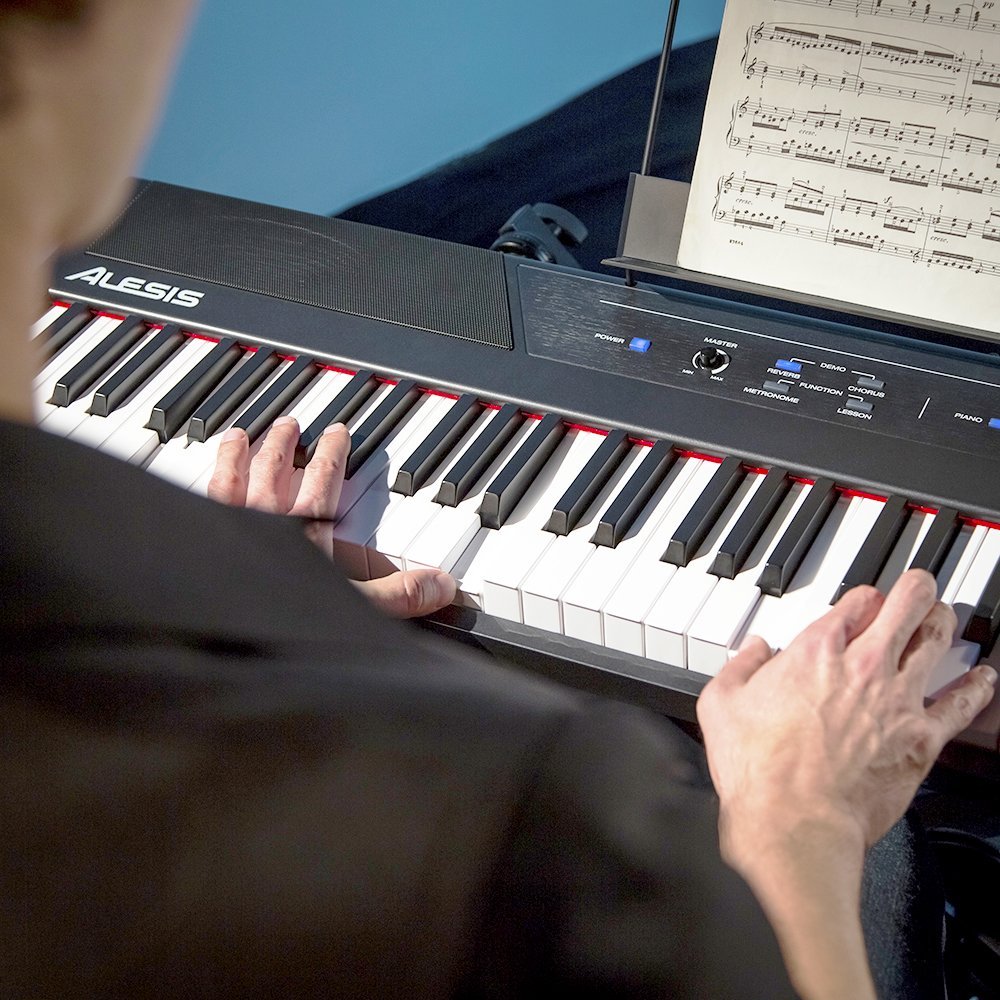
Product Specifications:
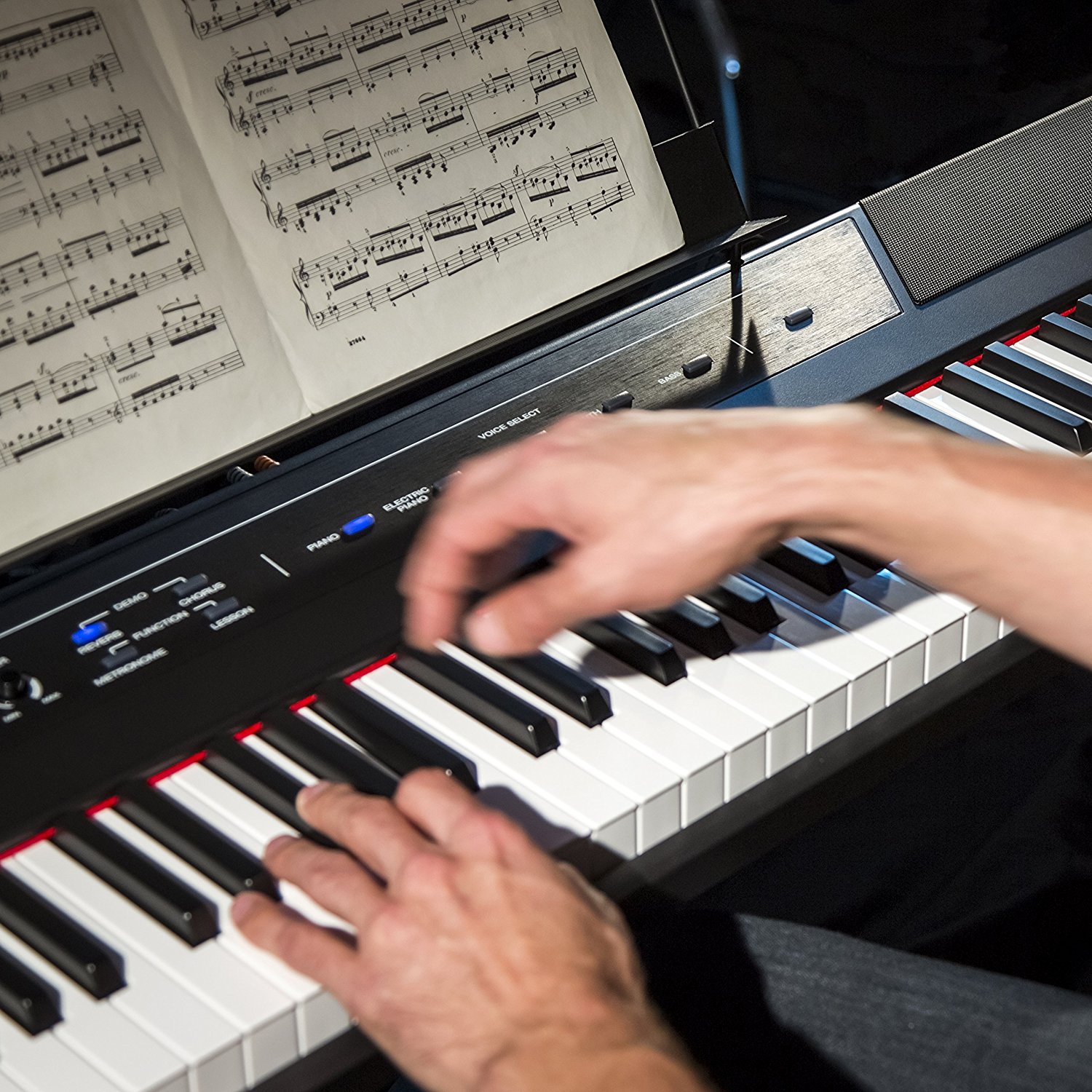
88 keys and that too full-sized and semi-weighted. With this digital piano you can actually learn how to play a grand piano.
Semi-weighted keys with adjustable touch response makes this possible. Moreover, you can even customize voices by joining two
together using the Layer mode or by assigning to either left or right channel with the split mode. Options such as Pedal Resonance FX, Chorus and reverb add to the mix allowing beginners to play around with the sound they create.
- Total of 88 full sized keys that features semi-weighted design and react to variable touch thanks to an adjustable touch response mechanism.
- The “Lesson Mode” is ideal for learning a keyboard as it targets pitch and voice separately instead of mixing together
several tracks to copy. - Skoove Premium subscription for three months is sufficient to make a professional out of anyone.
- All requisite connection ports are present – USB MIDI, Stereo RCA auxiliary, 1/4th inch headphone outs and 1/4th inch sustain pedal connection though a sustain pedal does not come as standard accessory.
- Powers through power adapters and will even run on six D size batteries if the need ever arises.
- Total of 5 built-in voices that include Bass, Synth, Organ,
- Electric Piano and an Acoustic Piano. Additionally, it allows for Split mode and Layer mode with these five voices.
What is in the box?
- 88 full-sized, semi-weighted keys.
- With built-in speakers.
Pros:
- Piano sounds are natural and true surround. Lower notes emanate from the left while the high stays mostly right speaker with the middle perfectly centered.
- Keys are sensitive and depending on how much you depress, they do affect the pitch and volume.
- Lesson Mode is well thought out and easy to follow. Even if you have never played a piano before, the Alesis Recital Lesson Mode will make a half-decent player out of you in few weeks.
- The organ voice is probably the best of the lot. Gave us the chills!
- Ability to run on battery does make this truly portable.
- Speakers are adequately powered though they do not have individual woofer and tweeter setup.
Cons:
- Being a beginner friendly keyboard, you actually miss out on quite a lot of add-ons but at least the basics are all there.
- While the keys are sensitive, they don’t actually feel all that good.
- They feel light and springy rather than semi-weighted.
- This piano distorts the highs and bottoms out on the lows if you use the built-in speakers above 60 percent volume.
- With a PA system or good pair of headphones though the sound is flawless and an excellent approximation of the real thing.
Final Conclusion:
Alesis as a music instrument maker has always managed to produce reliable and professional grade products. Even their accessories are all top notch and the Alesis Recital Beginner Friendly Digital Piano is no different. Yes, it doesn’t have a whole lot of features and voices but it does have a pretty amazing tutorial that can be further extended thanks to the included Skoove three-month premium membership. And finally the fact that for a beginner who advances far enough, there’s the option of using it with a computer makes it a well thought out instrument.

Despite the fact that I own multiple pianos including a Yamaha grand, I was quite excited to try this Alesis Recital electric piano. Alesis makes a lot of high quality music gear (I have one of their MIDI controllers), and a full size piano with weighted keys for around two hundred bucks sounded good to me.
And speaking of sounding good, this piano for the most part really does. Although it only comes with five sounds, you can split the keyboard to play two sounds on separate sections of the keyboard, or you can layer one on top of another for a much denser, richer sound. There is also a reverb and chorus feature to round out the sounds a little more. These are really key features because to be honest, the sounds themselves are quite thin. I think they are sampled sounds that were done at a very low rate, so they tend to fade or wash out as they move up and down. Especially the bass, which you would expect to do well in the lower registers, it instead turns into a slow, non-melodic “wub-wub-wub” as it goes down the keyboard. Hitting the key harder helped a little, but the sound was just not very good. I thought maybe the speakers were the issue, but the speakers on the keyboard are adequate enough. Still, you can really get more out of the keyboard by adding your own speakers. You’ll need your own sustain pedal (and bench, and stand), too, which is not provided with the keyboard.
The keys themselves are full size, thankfully, and it has the requisite 88 keys found on a regular piano, but the claim of them being weighted is simply not true. They have a spring action which simulates the real action of a piano, but the keys are very light and the action is more along the lines of a synthesizer. They are speed and force sensitive, so it is possible to get the effect of playing on a real piano, but the physicality is very different. I would not recommend this as a learning instrument for that reason, but it makes a good starter for someone who isn’t sure about sticking to playing the piano for the long run. (I doubt any performing musician would ever use this as a “gig” piano, although, it fits nicely on a typical “X” stand - see photo.) The sustain, also, is pretty much all or nothing. I did not notice any sounds fade as long as you hold down the sustain pedal, which is not the case with a real piano. Again, this is more like a synthesizer in that respect.
I didn’t try out the MIDI connectivity, which is through USB, but assuming that works as it should, this could make a pretty decent sound controller. With 128-note polyphony, you can really go to extremes of sound mixing and duration, but there are only 88 keys, so I’m not sure why Alesis bothered with that much sound making ability. The music stand is adequate, but you won’t be able to put much more than a medium sized lesson book on it. It is light, so the keyboard should travel well.
While playing and experimenting with this keyboard, I constantly reminded myself that it was not a real piano, but I ended up playing it, and enjoying it, for quite a while. My wife even said it sounded good, or in the case of the organ sound, too good. Really the only expectation that was not met was the feel of the keys, which are too light to be considered true weighted piano keys. Other than that, this versatile keyboard performs above a set of average expectations, which is why I rate it at four stars.
——————————————————————————-
This digital keyboard is both inexpensive and unimpressive. It’s not terrible, but you get what you pay for.
The feel of the keyboard, while advertised as “semi-weighted,” is cheap. The keys are plastic and spring back like organ keys. It is far from feeling like a piano or demonstrating “hammer action,” but it is perfectly playable and even expressive. It does feature the full 88-key range, and the keys are full-sized, which is a bit rare for a keyboard in this price range. It has good velocity sensitivity for dynamics.
The sound is another issue. In the mid-range, the piano sound (which is really the standard by which one should judge a digital keyboard) is fine. But in the top octave, it’s hard to listen to. The decay on the top notes turns into a harsh, high synthesizer sustain instead of a piano sound. It’s more apparent if more than one note is hit.
The low end reveals the limitations of the small built-in speakers. It is not particularly deep or resonant, and the player will never be lost in the illusion that they are playing a real piano. Of course, it sounds better with good headphones or running the RCA outs into a PA system. Overall, the volume of the keyboard is fairly quiet; I don’t think it could be used to accompany a live singer or even a small choir without a PA.
One really nice thing: It’s a true stereo keyboard, so the low notes seem to emanate from the left side of the instrument, the high notes on the right side, and the mid tones are right in the middle. It’s a nice illusion of reality. Note that this happens only on the piano sound, not the synth.
The other sounds are limited and uninspired. The organ sound is kind of a swirly wurlitzer/hammond sound, but there is no tone wheel or any way to change the speed or depth of vibrato. It’s one unalterable sound. The same can be said for the other sounds: the electric piano is so-so. The synth is abrasive and unchangeable, and the bass sound is plunky and synthy. Layering of sounds is easy though: just press two buttons together to get two sounds at once.
The piano does not come with a sustain pedal, but there are some affordable options on Amazon. I recommend the style that looks like a piano pedal, not the ones that are just a square trigger. The Cherub WTB-005 is $15.00 or so and is just fine.
Usability is a real mess here. Whatever features this keyboard has beyond just selecting an instrument and playing are difficult to manage. Even the metronome does not have an obvious way to change the tempo or volume. Without the user’s manual, you will be lost; every function involves putting the keyboard into “Advanced Mode,” then pressing combinations of the piano keys to make the changes. Except that there is no labeling on the actual keyboard to tell you what the keys do; you must consult the manual. Here’s an example of how to change the tempo of the metronome, right out of the manual: “Press the Metronome and Lesson buttons at the same time to enter the Advanced Function mode… Use the keys marked TEMPO + or TEMPO - to adjust the tempo value.” The problem here is that NO KEYS ARE MARKED. The supposedly marked keys are C5 and D5. The manual goes on to explain how you can also use the keys to type a number (G5=5, B5=9, etc.). So to use this keyboard easily, the user will need to apply a strip of white tape to the keyboard and label each key with the Advanced Function.
For a beginner (or for a child learning to play) this may be a good. There are few distractions here such as numerous annoying “demo” songs, drum-kit sounds, microphone samplers, etc.
This is not a pro instrument, but it is adequate for light home use or for a beginner. I would not consider taking this to a gig; it just seems so lightweight that I fear it is not durable. Time will tell. The weight, while a bonus for many users, is actually so light that the piano slides, and feels unsteady even on a sturdy professional stand.
PROS: Cheap, easy to use, very lightweight and portable. Full 88 keys with USB Midi and decent RCA and headphone outputs.
CONS: Sound quality, speakers, cumbersome advanced usability, no included sustain pedal.